
BougeRV Electric Folding Wagon Review (2026): Great for Car Camping

*The Wild Guides is reader-supported. When you buy through links on my site, I may earn an affiliate commission at no extra cost to you. Learn more*
Last updated: July 2026 · Tested over front-country camping trips in Alberta
The short verdict
The BougeRV Electric Foldable Utility Wagon is a 440 lb-capacity folding cart with two 250-watt hub motors and a removable 133Wh battery that doubles as a USB power bank. On gravel, packed dirt, and hard trail, it genuinely works — I loaded it to roughly 150 lb (68 kg), pointed it up a slight grade, and walked beside it doing almost nothing. On grass, the hard plastic tires spin. If your campsite is gravel or hard-pack, this is a real upgrade over a manual wagon. If it’s turf, you’ll need to work harder, but it still works.
Score: 5.0 / 5 on gravel and hard-pack — 3.0 / 5 on grass.
| Best for | Front-country campsites, gravel access roads, hard-packed trails, festival and beach hauling |
| Price | ~$399 USD (check current — it moves often) |
| Bottom line | Excellent motor and build, one slightly limiting flaw |
Use the code EW666 to get 6% Off! Valid until 31st of August 2026.
Pros and cons
What I liked
- The motors are the real deal. 150 lb up a slight grade felt like pushing an empty cart.
- Steering in tight spots was better than I expected, and better than some reviews suggested.
- Build quality is solid — carbon steel frame, heavy Oxford cloth, nothing flexed under load.
- The battery pops out and charges phones. Small thing, genuinely useful at camp.
- It rolls perfectly fine with the power off, so a dead battery isn’t a dead wagon.
- One-strap fold. Pull up, done.
What I didn’t
- Grass traction could be improved. Hard plastic tires, no bite. Some rougher pattern rubber tires may be more suitable for softer, wetter terrain.
- Brakes are basic. With real weight behind you on a downhill, you’re part of the braking system.
- It’s bulky folded. It fits an SUV, but something else has to come out.
- The display washes out in bright sun.
- No aftermarket tire option that I can find.
Specs at a glance
| Spec | Detail |
|---|---|
| Load capacity | 440 lb / 200 kg (static) |
| Cargo volume | 180 L closed, 250 L with tailgate down (190 → 264 qt) |
| Motors | 2 × 250 W brushless, rear hub |
| Battery | 133 Wh, 24 V, removable, USB-C rechargeable, doubles as power bank (USB-A + USB-C out) |
| Claimed range | Up to 12 miles / ~19 km |
| Speeds | 3 settings — 1.79 / 2.46 / 3.13 mph (2.9 / 4.0 / 5.0 km/h) |
| Max incline | 15° or 30° depending which listing you read — see below |
| Wheels | 7 in diameter × 4 in wide, solid “tank” style |
| Unfolded size | 39.4 × 24 × 24.8 in (100 × 61 × 63 cm) |
| Weight | Just under 40 lb / 18 kg |
| Frame | Carbon steel, multi-layer paint |
| Brakes | Posture-sensing, electronic lever, foot brake, hands-free auto |
| Charger | Not included on most listings — bring a 65 W USB-C PD brick |
| Warranty | 2-year tech support |
Who this wagon is actually for
Reviews that say “great for everyone” are useless, so let me be specific.
Buy it if: you camp at established sites with gravel pads and gravel access roads; you haul firewood, water jugs, coolers, or bins more than about 50 metres; you’re hauling gear over hard-packed trail; you have a bad back, a bad knee, or you’re hauling for a group and doing three trips instead of one.
Wait and see if: you want it for backcountry work or game retrieval. That’s my next test, in autumn. More on that at the end.

What makes it different from a regular folding wagon
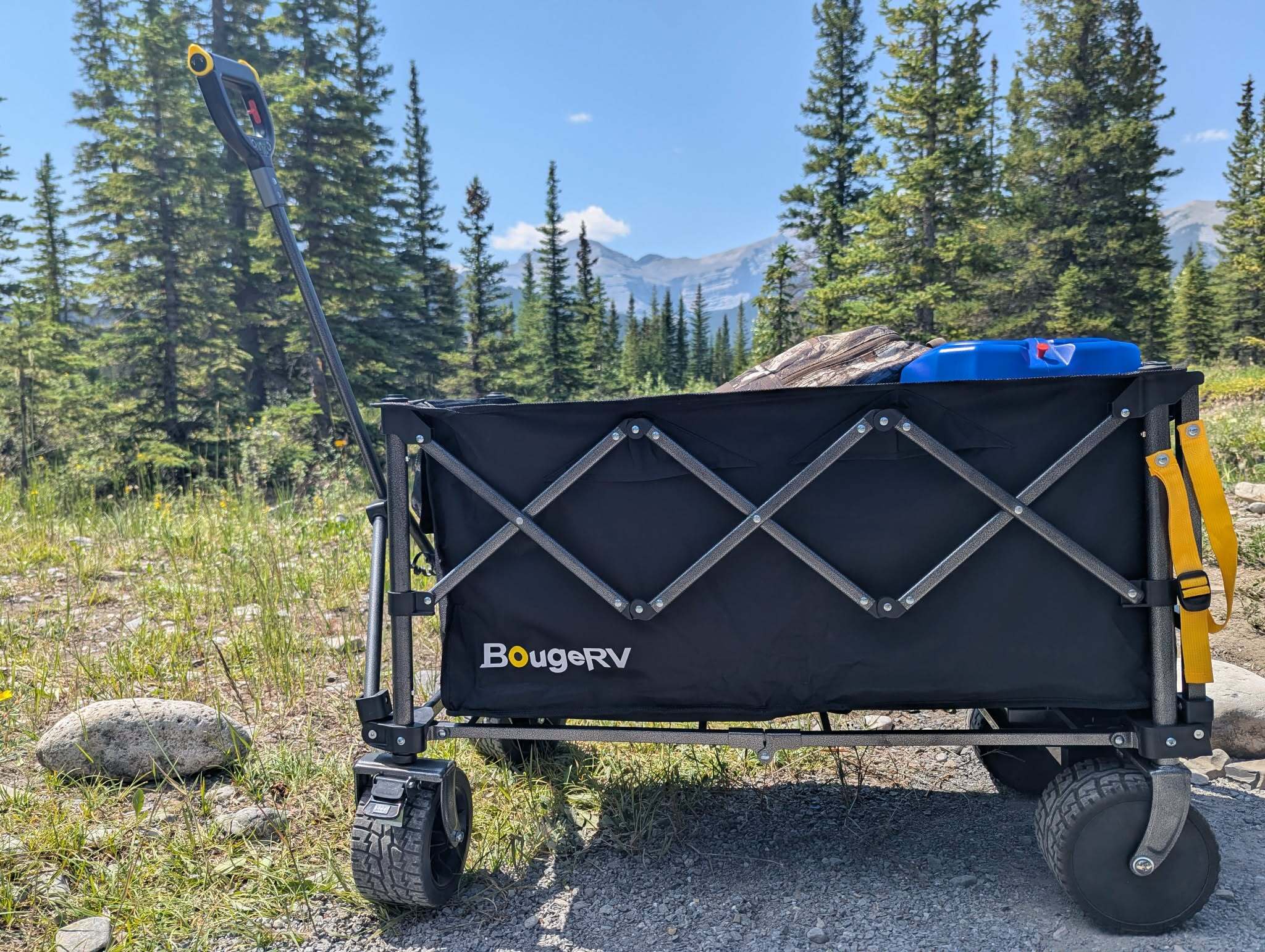
A manual folding wagon like the Mac Sports style cart costs $50–120 and you are the engine. This one has two 250 W brushless motors built into the rear wheels, a thumb throttle on each side of the handle for forward and reverse, and three speed settings. You walk. It drives.
The handle carries a small display with battery percentage and current speed mode, a power button, and a mode button. Because there’s a throttle on both sides, it works left- or right-handed, which is a nice touch nobody mentions.
Crucially, and this matters more than the spec sheet suggests: with the power off, it rolls like a normal wagon. No resistance, no drag from the motors. If you kill the battery two kilometres from the truck, you’ve got a heavy manual wagon, not a boat anchor.
Setup and first impressions
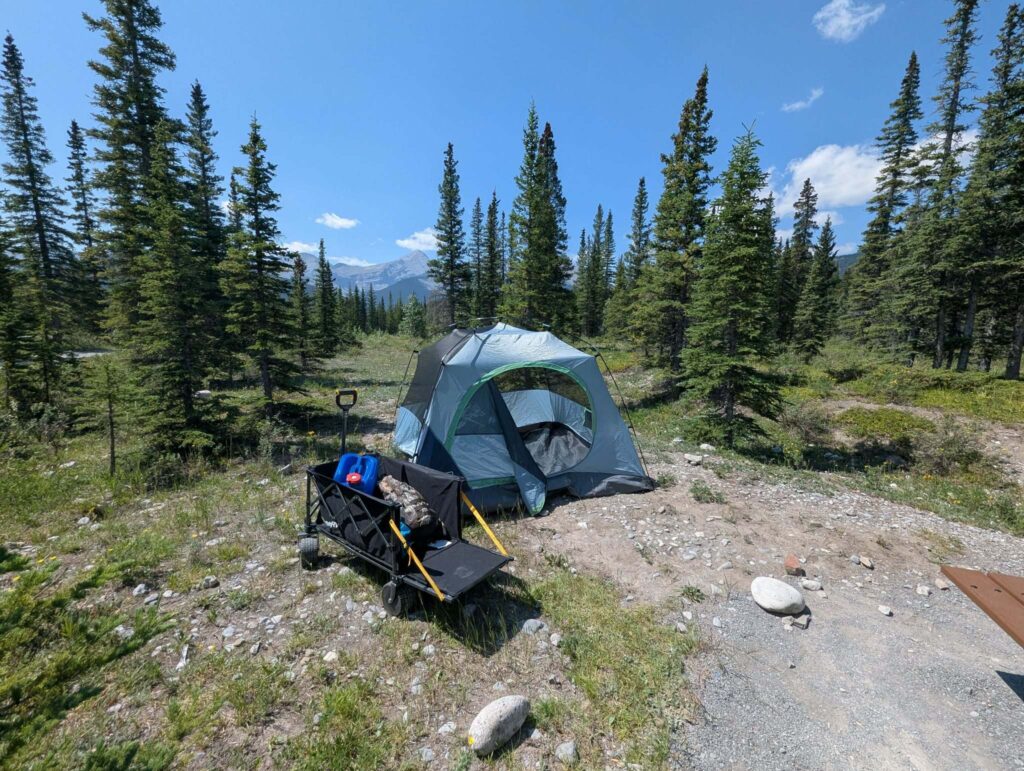
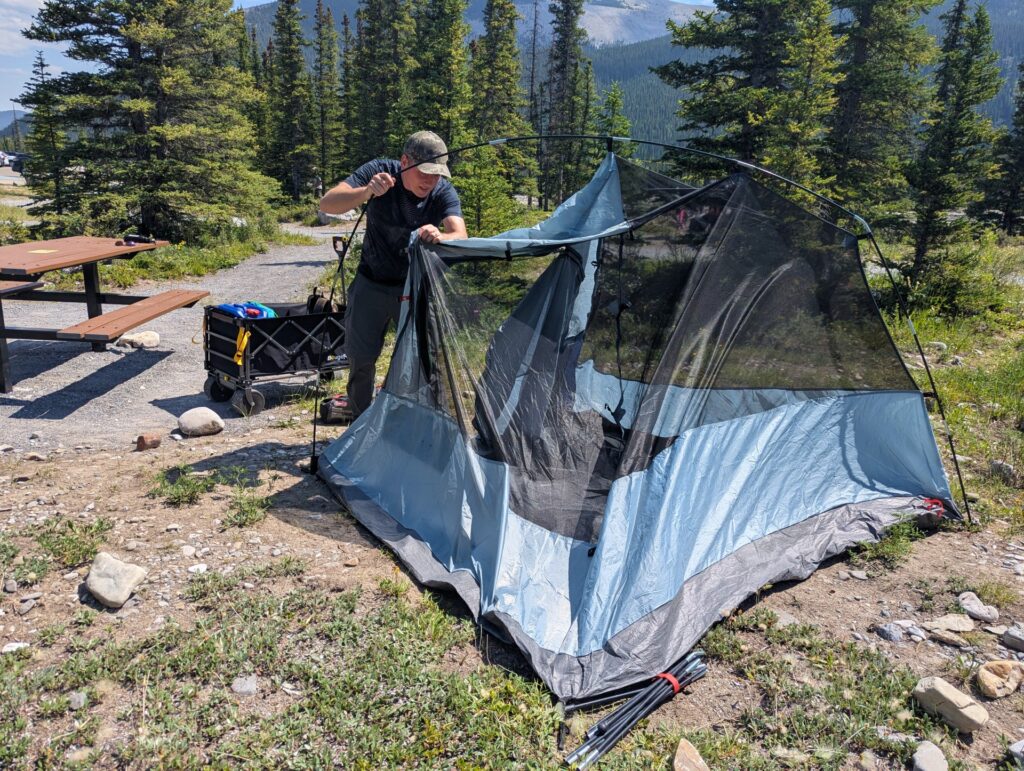
Mine arrived mostly assembled. Front wheels push on, one power cable connects, the handle screws on. Fifteen minutes with no drama and no tools I had to hunt for.
Two notes on the box contents that trip people up:
- The battery is included. Good — it’s the expensive part.
- A charger often isn’t. BougeRV’s own listings say so plainly. It charges over USB-C, and the speed difference is significant: roughly 9–10 hours on a 15 W adapter versus 3–4 hours on a 65 W USB-C PD brick. If you already own a decent laptop charger you’re set. If not, add one to the order, because a 10-hour charge cycle at camp is a wasted day.
Folded, it stands on its own on those wide wheels, which is more useful than it sounds in a garage.
Gravel and hard-pack: this is where it earns its money
This is the good news, and it’s genuinely good.
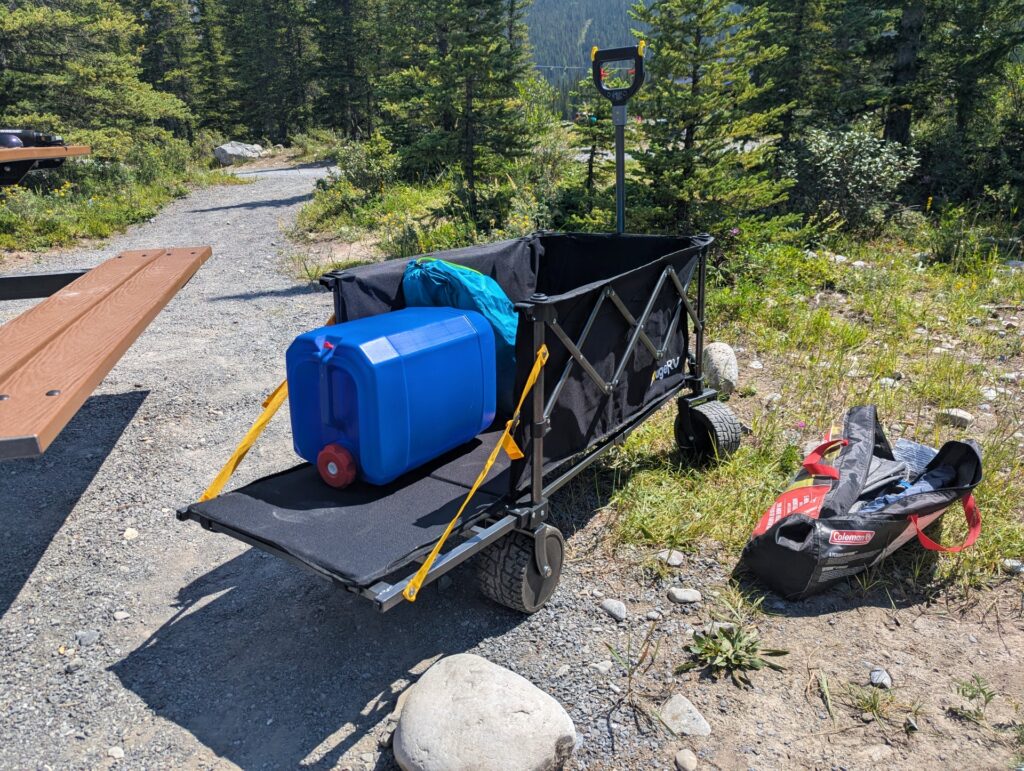
I loaded it with roughly 65–70 kg (145–155 lb) of camp gear — water, cooler, bins, the usual pile — and ran it along a gravel campground road, including a slight uphill and a slight downhill. Powered on, in second gear, it just went. My job was steering. The motors dealt with the grade without any audible strain and without me leaning into the handle.
For scale on what that means: a full cooler and two water jugs is the point at which a manual wagon starts fighting you on any kind of slope. Here it was a non-event. That is the entire value proposition of this product, and on this surface it delivers exactly what BougeRV claims.
Steering surprised me. CNET’s reviewer found it clunky in tight spaces because only the front wheels pivot, and mechanically that’s true. But threading it between trees and around picnic tables at a campsite, I had no complaints. My guess is that it’s fine in the outdoors and awkward indoors — his worst example was getting out of a small elevator, which is not a problem I have while camping.
Noise: it’s an electric motor, so there’s some, but it’s mild. Powered off it’s near silent. Worth filing away for later.
Grass: the one issue
Here’s the finding I haven’t seen in any other review of this wagon, and for some, it can be important
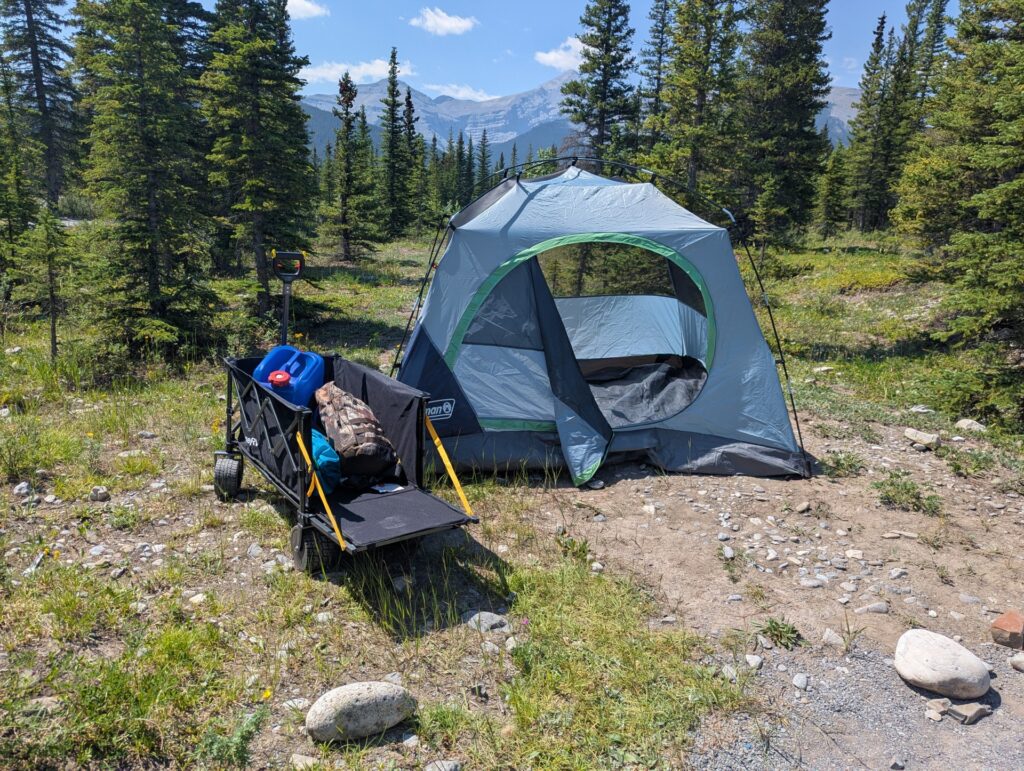
On grass, under load, without manual assistance, the wheels spin. Not “loses a bit of traction.” Spins. The tires are hard solid plastic with a moulded tread, and on turf they polish the surface instead of digging into it. Add any grade at all and you’re back to pulling by hand — which is still easier than with a manual wagon, as you get the additional powered assistance. But if the battery dies, you’re left with a heavy utility wagon, you need to pull up with all its contents.
I believe this is not a build-quality issue. The frame, motors, and battery are all fine. It’s a tire compound and tread problem, and it’s fixable — by BougeRV, with a rubber or knobby pneumatic option. As far as I can tell, no such option exists yet, and the wheels aren’t a standard size you can swap from a hand-truck. However, I hope they create a set of wheels or tires/mounts that will solve this problem.
Why this matters more than a spec-sheet footnote: I believe this utility wagon could be perfect for game retrieval during the hunting season, and this would allow users to feel more confident using it on hilly terrain, that can be very diverse and humid at the same time.
If BougeRV is reading: offer a rubber tire kit. I’d buy it, and I suspect so would everyone else who’s tried this on a lawn.
Battery life in practice
What I can tell you is that battery anxiety never entered the picture. Over a weekend of repeated shuttle runs between vehicle and site, the battery was never the limiting factor and never sent me looking for a charger.
That’s consistent with the numbers other testers have reported. One reviewer covered roughly 5 km including steep inclines and used under a quarter of the pack — which, for a 133 Wh battery, is a sensible result. The 12-mile claim is best read the way you’d read an EV range figure: achievable empty on flat pavement in third gear, not while hauling 150 lb uphill.
For realistic camp use — dozens of short runs of 50 to 300 metres — you are nowhere near the limit. For a long single haul on a rough access road with a heavy load, plan conservatively and remember that it still rolls with the power off.
The power bank function is a genuine bonus rather than a gimmick. It’s a 133 Wh pack with USB-A and USB-C out, which is roughly ten phone charges sitting in your cart doing nothing.
Brakes, control, and can you actually ride in it?
There are four braking mechanisms and the marketing makes them sound more sophisticated than they feel in the hand. Practically: the handle brakes automatically when upright, there’s an electronic lever, and there’s a foot brake.
They’re adequate but basic. With real weight behind you on a downhill, you are still part of the braking system. Not alarming at camp speeds on a modest grade, but I’d want more confidence before taking a heavy load down anything genuinely steep. On grass, the slip issue works against braking too.
And the question everyone asks: can you ride in it? We tried. My wife climbed in and attempted to drive from inside, and the answer is a clear no. Loaded with a person, it won’t steer — the front wheels need weight off them and forward momentum to turn, and there’s no way to manage that from the cargo bed. Treat this as cargo-only. If you want a rideable version, that’s a completely different and much more expensive product — see the comparison below.
Does it fit in an SUV? (The RAV4 answer)
I run a 2024 Toyota RAV4, and this is the practical question nobody answers properly.
It fits — but there’s a trade-off. Folded, the wagon went in the back of the RAV4, and then I had to take other things out. It’s just under 40 lb and it folds flat-ish, not small. In a pickup bed it would disappear and you’d never think about it again. In a mid-size SUV packed for a family camping weekend, it’s a bit of a trade-off you have to plan for.
Worth thinking through honestly before you buy: is one bulky item worth removing to save four trips carrying gear? If you have a lot of heavy items you need to haul, and it’s killing your camping enjoyment, then you’ll make space for it. If it’s costing you space you need for other items, you may want to skip this tool.
The incline number nobody checked
Here’s something odd I ran into while researching this, and it’s worth flagging because it affects buying decisions.
BougeRV’s own listings contradict each other on maximum incline. Some product pages and retail listings state the wagon climbs slopes up to 15° under a 100 kg load on smooth surfaces. Others, for what appears to be the same or near-identical unit, state 30° under the same conditions. Both figures appear on Amazon listings under BougeRV’s own brand, and the Walmart listing title says 30° while the bullet points say 15°.
That’s a factor-of-two difference in the single most important performance claim for anyone buying this for hilly ground.
My own testing was on slight grades, so I can’t settle it. What I’d suggest: assume 15° when planning, treat 30° as a best case on ideal surfaces, and if you’re buying specifically for steep ground, contact BougeRV and ask them to confirm the figure for the exact SKU you’re ordering.
Also note: 15° is about a 27% grade, and 30° is about a 58% grade. The second number would be genuinely remarkable for a 500 W total system pushing 200 kg. Draw your own conclusions.
I’ll have more information on that after my hunting season hauling experiences, where the terrains are much hillier and diverse.
How it compares
| Model | Price (approx) | Load | Battery / power | Notable |
|---|---|---|---|---|
| BougeRV Electric Foldable Wagon | ~$399 | 440 lb | 133 Wh removable, 2 × 250 W | Power bank function, biggest capacity in class, great on hard surfaces |
| Litheli Electric Utility Wagon | ~$250–300 | 450 lb | Removable, variable speed | 150 L, all-terrain wheels, smaller cargo volume |
| Litheli W1 Pro garden cart | ~$180–300 | 132 lb | Removable | 200 L, 8 in tires, much lower load rating |
| Portal Electric Wagon Cart | Varies | 450 lb static | 24,000 mAh, 300 W | 180 L, push and pull modes |
| Navee E-Wagon 4X | ~$2,099 | Heavy | 36 V, 3000 W | Rideable, 10 mph, ~45 mi range, 50% grade rated, a totally different price point |
| Mac Sports manual wagon | ~$50–120 | 150–300 lb | None | The baseline. You are the motor. |
Reading the table: BougeRV wins on cargo capacity and the power bank feature, and it sits in the sweet spot on price for a powered cart. The Navee E-Wagon 4X, launched at CES 2026, is a different category — five times the price and you ride it. The Litheli units are the closest real competitors and use larger 8-inch wheels.
Prices in this category swing hard on sales. Check before you commit.
Coming next: the hunting test
This review covers camping only, and it’s the easier half of the story.
The real test is this autumn. I’m taking this wagon out hunting, and if I’m successful, I want to know whether it can retrieve meat over ground that has no path on it at all. That’s a much harder ask than a gravel campground road, and it’s the use case where a powered cart would genuinely change a day for the better — a boned-out animal is exactly the kind of load a 440 lb cart should shrug at.
It would also make waterfowl hunting a breeze, considering all the decoys and hauling out birds after a successful hunt (geese are heavier than they look!).
Based on the grass results, I have some doubts but also a real hope. The motors are strong enough. The question is entirely whether those tires can put the power down on ground that isn’t hard-packed. I’ll also finally get cold-weather battery data, since this test happened during an Alberta heat wave and lithium behaves very differently at -5°C. I am hoping that even with the traction issues, the motor will help me just enough to haul the meat out of difficult terrain.
Part two lands this autumn — here’s my hunting gear coverage in the meantime.
FAQ
Is the BougeRV electric wagon worth it? For gravel, hard-pack, and established campsites, yes — the motors meaningfully reduce effort and trips. For soft grass and turf, the hard plastic tires undercut the whole system and it makes the haul harder than on solid ground. However, it’s still easier than pulling a loaded utility wagon manually. So, I’d say it is worth it.
How much weight can the BougeRV electric wagon carry? It’s rated for 440 lb (200 kg) static load. I tested to roughly 150 lb (68 kg), and at that weight the motors showed no strain on gravel.
Does the BougeRV wagon work on grass? It does, but not as great as on hard surfaces. Under load, the solid plastic tires spin rather than grip. This is the single biggest limitation of the product. However, if you pull at the same time, the wheels get a grip and the motor does help you with the efforts needed to pull a heavy load of gear.
Does the battery charger come with it? Usually not. Most BougeRV listings state the charger is excluded. It charges over USB-C — expect 9–10 hours on a 15 W adapter or 3–4 hours on a 65 W USB-C PD charger.
How far can it go on one charge? BougeRV claims up to 12 miles (19 km). Treat that as a best case. Real range depends heavily on load, terrain, and speed setting. For typical camp shuttling it’s more than sufficient.
Can you ride in the BougeRV electric wagon? No. We tested it. With a person in the bed it won’t steer, because the front wheels need to be lightly loaded and rolling forward to turn.
Does it work as a normal wagon if the battery dies? Yes. With the power switched off it rolls freely with no motor drag. Note that you must turn the power off before pulling it manually.
Final verdict
The BougeRV Electric Foldable Utility Wagon does the hard part well. The motors are strong, the build is solid, the battery outlasts realistic camp use, and the power-bank trick is a genuine bonus. Pushing 150 lb up a gravel grade while barely touching the handle is exactly the small luxury it promises to be, and after a weekend with it I understood why powered carts are suddenly everywhere.
It’s a bit held back by one fixable thing. Hard plastic tires that spin on grass limit a product that’s otherwise well engineered, and a rubber tire option would move this from “good on the right surface” to “recommended without caveats.”
If your ground is gravel, dirt, or hard trail: this is a strong buy at $400.
Score: 5.0 / 5 on hard-pack (great job) — 3.0 / 5 on grass (needs more manual assistance)
| Category | Score |
|---|---|
| Motor power and climbing | 4.5 / 5 |
| Build quality | 5 / 5 |
| Battery and range | 5.0 / 5 |
| Steering and control | 5.0 / 5 |
| Braking | 3.0 / 5 |
| Traction on grass | 3.0 / 5 |
| Packed size and portability | 3.5 / 5 |
Have you run one of these on soft ground, or found a tire that fits? Leave a comment — I’d genuinely like to know before the autumn test.
Check out my other Bouge RV gear reviews:
